
The Need for Roots
We seem to have given up ownership of our football clubs in return for detached entertainment, but an engaged community, though harder and less shiny, would surely have deeper meaning.

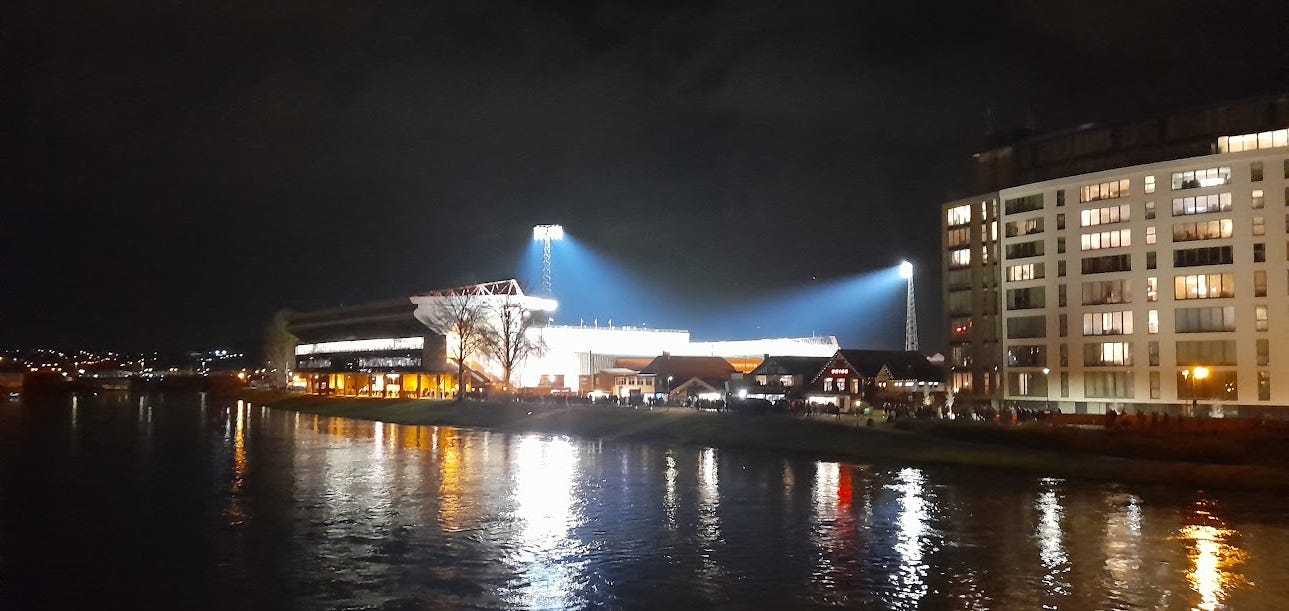
It has been quite a rollercoaster of a year. The excitement of building on last season’s achievements with Nuno Espirito Santo, followed by the breakdown of his relationships within the club and ultimate departure. The disastrous appointment of Ange Postecoglou, who seemed to still be dealing with the demons of his own break up with Spurs and allowed them to poison any chance of success here. Then Sean Dyche with his familiar backroom team, the release of a victory against Porto followed by an unease that even with some results it wasn’t quite right. Much of that with the season barely underway, before finally almost going back to the start with Vitor Pereira.
Did we fall briefly into a nightmare and then shudder awake to find ourselves safe in our own familiar beds ready to resume our journey as if 2025/26, or at least the shakier bits, never happened? It’s hard to say, because arguably what this season has done is remind us that nothing good we have has any roots. It can at times feel like we know who we are and where we are heading, but in reality we are vulnerable to the slightest storm. In part that is the nature of the Premier League where most clubs are only a few bad decisions away from oblivion, but it is also inherent in the running of this particular club, our club.
Earlier in the season I went to watch East Cowes Victoria play against Andover New Street in the Wessex League Premier Division. There is a strand of our family rooted in the Isle of Wight town and in the aftermath of my mother-in-law’s death we went to spend some time with family and friends. An uncle used to play for the Vics decades ago and there was a tradition of family growing up watching the games, so it felt right in this time of mourning to finally visit their Beatrice Avenue ground and take in a game. We paid £7 each and took our place on a shallow covered terrace.
At step 5 of non-league the ground features a small seated stand, that was pretty much full when we got there, alongside the shallow, roofed terrace we stood on, two open sides behind the goals and another small terrace on the opposite length. There is a welcoming clubhouse, with bar, seated area and a large TV for following the scores elsewhere, and outside a kitchen hatch serves the usual refreshments. A crowd of 155 friendly and approachable locals settled in for a game that was expected to be challenging with Andover sitting 4th in the league.
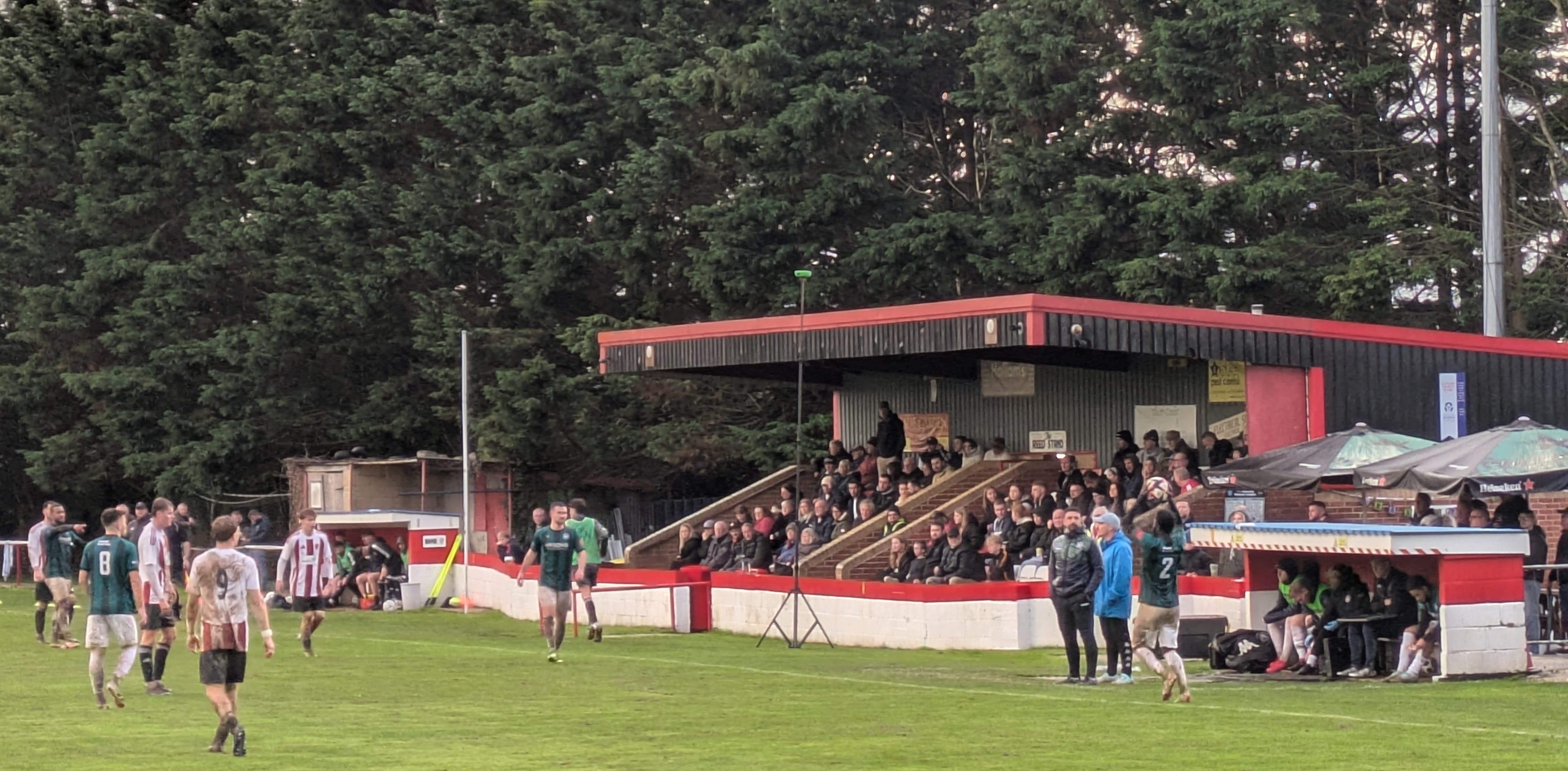
Nine tiers down the pyramid might seem a long way but football is the same whatever level you play it, two teams competing on a patch of grass. The Vics were keen to play a passing game that was pleasing on the eye and they scored a goal that would grace any level to take and ultimately hold the lead. As half-time approached the skies went very dark before unleashing a torrential downpour that threatened the game, but fortunately despite leaving a very squelchy pitch behind it didn’t rob the home side of a well deserved victory and three points.
With FIFA bestowing their latest abomination, the FIFA Football Peace Prize, on a US President glibly “unleashing hell” around the world, I feel a strong urge to run as far from the elite game of football as I can. The gag inducing Infantino keen to curry favour with his repulsive pals in the corridors of world power and wealth, says it was awarded in the name of all football fans, though he’s never asked us. The World Cup has been tainted for years as a capitalist monstrosity, but manages now at each iteration to become ever more disgusting as it tries to normalise and even celebrate kleptocrats and authoritarian regimes. Turning it off and distancing yourself from it is the only response, but how far is a safe distance?
I find myself torn because my connection to Nottingham Forest is deep, but the club I see now has no roots. There is no real basis for wanting this group of expensively assembled signings to win than any other group they might come up against on a matchday. The only distinguishing feature is the shirts as they run out in a relentless rotation of available to purchase kits carrying the image of a tree by a river. What connects them to Nottingham? What defines them as Forest? Whilst there are genuine sporting stories to be enjoyed, not least in Morgan Gibbs-White, Elliot Anderson and Neco Williams in the current team, it is sobering that they cost three times the annual turnover of a large second tier club to sign.
Back when we were a mere EFL club and the wider world didn’t take so much interest in us I wrote a piece about how I would like to see a Championship club secure promotion to the Premier League but then turn it down. When Forest finally broke their 23 years of exile and Steve Cooper guided them to the top flight any owner would have been lynched for doing so, and anyway the required billionaire at the helm of any ambitious club these days would have a heart attack at such a notion, but reflecting on it all now what a statement that would have been.
Like so many aspects of our culture football is all about consumption. Whether it’s the escalating ticket prices, the dazzling offerings from the club shop, the array of TV subscriptions to keep in touch with every competition, or the over complicating of the rules to drive demand for greater technological solutions, the focus of the game is to extract money. Social media output tries to flog us narratives of connection and community, but the reality is transactional, payments for results and if either stops, stop.
I’m not sure that there is a line that we can draw and say above it is bad and below it good. Another club I have a connection to is Eastbourne Borough. A couple of years ago this community interest club was bought by a businessman who wants to “transform non-league football”, but at the same time he says he wants to take Borough into the Football League, so he’s hoping to simultaneously transform the non-league game and get out of it. That’s not to criticise what he is doing in Eastbourne, I don’t know enough about what is happening on the ground there, but it does highlight a problem in what used to be the amateur game and it mirrors the one in the Championship, no one values it for its own sake only as a route to somewhere else.
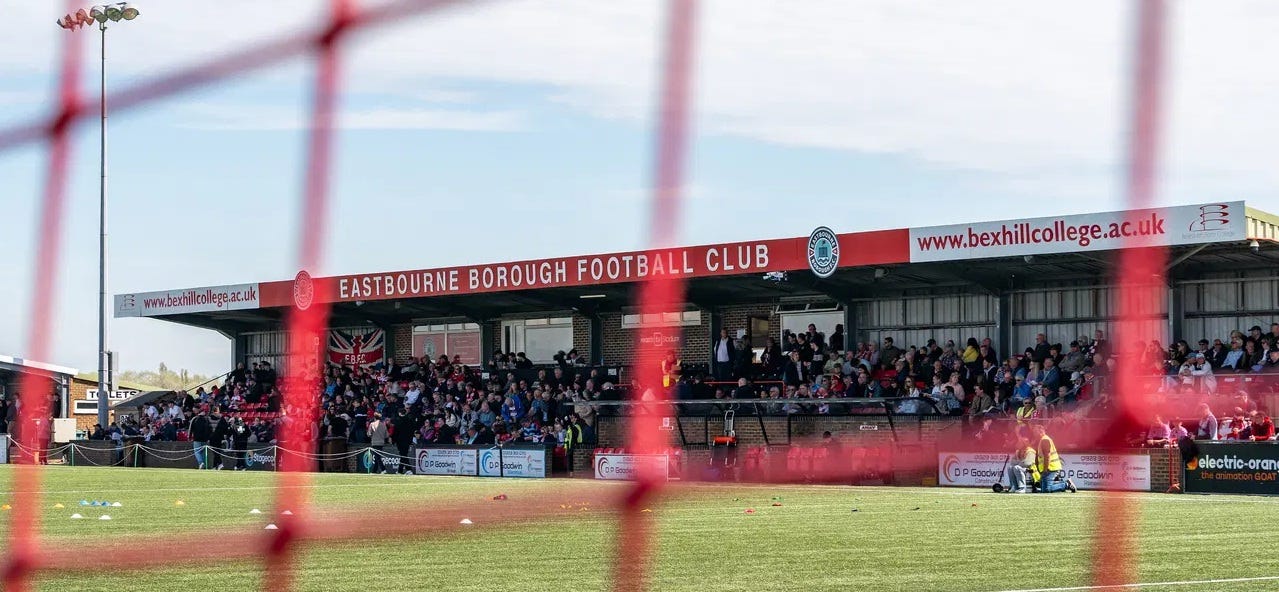
For the two years for which Eastbourne have posted micro entity accounts since Simon Leslie took over they appear to have lost close to a million pounds in each and now in his third season they have been relegated from the National League South. I’m sure he’s devastated, that wasn’t part of the plan, but football at this level surely shouldn’t require millionaires anymore than the Premier League should be relying on billionaires. Leslie made Eastbourne full-time in the hope this would support promotion to the league level, but the reality is that the best (or most appropriate) players in the Sussex non-league pool are balancing amateur status with jobs outside the game, so the available options shrink with professional status.
Having a single point of leadership and decision making at an organisation that was once a community asset with a strong association to its place and people, also degrades the connection between the club and its support. An influx of money and ambition can be enticing but if results don’t immediately follow it inevitably builds resentment and discontent. Something has been lost with the change in identity and whilst some success can paper that over for a while at least, failure just opens that wound wider. An owner can bemoan a lack of support when times are tough, but it didn’t used to be about just results when it was community owned and run.
The same can be said back at Forest where the club has effectively become an extension of its owner’s personality. Occasionally he’ll try to reference some aspect of our history, or the marketing department will see some traction in a fan led display, but Nottingham Forest is now a Marinakis club, part of the Marinakis group, and it behaves in the way he behaves, for good and ill. Under Marinakis the club is making a “new history” and despite the enormous revenues of the Premier League it is a history that can only be made by massive external cash injections beyond the reach of any but a few extremely rich individuals.
It has been a torrid year for Eastbourne Borough, three different managers but a constant stream of defeats that left them rooted to the bottom of the table. It was also the year they released a homemade documentary about last season, when they were chasing promotion before finally losing out in the playoffs. That series of enjoyable films revealed two sides to the club, a group of local people for whom supporting Borough was the ebb and flow of their lives as they dealt with personal triumphs and tragedies, alongside a wealthy businessman carrying the weight of frustration that his individual vision was proving hard to realise.
Relegation might prove to be an opportunity for a balance to be found with a new way forward that allows both this successful businessman and the community that built Eastbourne’s youngest but now highest placed football club to thrive together, or it might just bring more frustration if a fractured club struggles to deal with new challenges. Results are always the goal for any club, but there are bigger reasons we are bound to these historic, locally rooted entities that can be overshadowed by the arrival of personal egos that need quantitative metrics to measure their impact.
Back at Forest we’ve survived the looming threat of relegation, that would be even more daunting at this level than for Eastbourne, and we’ve had a European adventure for the first time in a generation. In fact, we’ve been ticking off first in a generation milestones pretty much constantly for the last four years so it feels churlish to complain, and that is Mumford’s “magnificent bribe” playing out in this simple game of kickball. Despite some unsettling areas of the game’s ownership and governance, it feels too good being part of the Premier League to want to let it go, at least for now, and there is a fear that unless we toe the line it could all be lost.
I first took my son when tickets were plenty and affordable, and he’s a bit stuck with it now, which is how it’s supposed to work with your club. As a result, I’m a bit stuck with it too. I probably would have given up watching if it wasn’t for him, and if I was having my family now I’d probably be taking them elsewhere, whether that be another club or another hobby entirely. I don’t get much from watching a billionaire wave his money around and the club I see now isn’t one I would likely pick to support, but 40 plus years of habit is hard to break.
I recently read a book about Union Berlin. They’ve gone through considerable success whilst retaining, and building, a community based in a particular place, but there are definite tensions appearing. The book constantly goes back to the focus needing to be on that place, those people who are local to it, working towards a common goal, earning success not buying it, prioritising the people in the physical space over commercial opportunities and international markets. That’s the football I’m interested in, I realise that the “problems” are always there but there is an orientation that puts values and identity over money and results.
We shouldn’t overplay any creation myths about a football club, nor should we seek to create some sort of rigid purity test that excludes either newcomers or change, both of which are essential to any community, but we should be able to form some sort of cohesive history that shapes the distinctive flavour of Nottingham Forest verses any other club. There should be a reason to choose Nottingham Forest that is rooted in the place of Nottingham and the people who have been a part of it over more than 160 years since it formed. It’s not enough to scream and kick out in the face of defeat, or to tear it all up to appease the emotional reaction of a single point of power.
It’s no surprise that the same things that frustrate me about the globalisation project in general also frustrate me in football. The insistence on breaking connection to places, communities and old stories in favour of a global homogeneity that can be easily analysed, influenced and turned into more efficient units of consumption. The ability to wade in with global capital that prices out local, small scale projects, changes the physical, social and economic landscape and then rides out with the profits with no connection to or interest in the hollowed out places and communities it leaves behind.
As we reflect on recent local elections in this country, and those currently clinging to the crumbs off the table of that system look disparagingly on the choices of those discarded by it, we might also wonder whether building a stronger, more united community that shares in the deep history of a diverse but interconnected English football pyramid, will serve us better in the long-term than competing against each other for an immediate hit of venture capitalist “investment”. It wouldn’t be as glitzy, exclusive or infused with relentless drama as it is now, but it would somehow be more real, more us.
Ultimately though, after years of going round these arguments, I realise that it is too much to ask. Even amongst those who can see the problems, like all crises that require personal sacrifice, it becomes easier to accept the bribes than face the messy and unpredictable reality of authentic existence. It’s draining when something that plays such an enormous part in your life feels so wrong and you want to change it, when you don’t want to give up on your core values and your hope for something better, but the tide you are fighting against is overwhelming. So, dropping resignedly into a chair and turning the telly on for another round of games maybe at last it is all right, everything is all right, the struggle is finished. We love the Premier League.